-200x45.png)
Choosing the right single-shaft shredder is an important decision for recycling plants, waste management companies, manufacturers, and material processing businesses. Different materials have different characteristics, including hardness, moisture content, density, size, shape, and composition. A shredder designed for plastic may not be the best solution for wood, rubber, textiles, or bulky waste.
The right single-shaft shredder machine can improve processing efficiency, reduce operating costs, achieve a more consistent output size, and extend equipment service life. However, selecting a machine based only on the material name or motor power can lead to poor results.
So, how do you choose the right single-shaft shredder for your material?
This guide explains the most important factors to consider before purchasing an industrial single-shaft shredder.
What Is a Single Shaft Shredder?
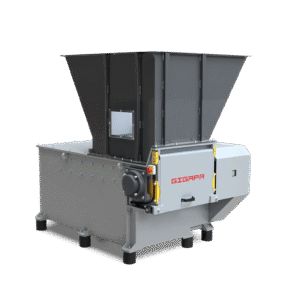
A single shaft shredder is an industrial size-reduction machine designed to process a wide range of recyclable and waste materials. It normally consists of a horizontal rotor equipped with cutting knives, a fixed counterknife, a hydraulic pushing system, a screen, and a drive system.
During operation, the hydraulic ram pushes the material toward the rotating rotor. The knives grab and cut the material against the fixed counterknife. Once the shredded material reaches the required size, it passes through the screen.
Compared with some other types of shredders, a single shaft design offers controlled material feeding and relatively consistent output sizing. It is widely used in:
- Plastic recycling
- Wood waste processing
- Rubber recycling
- Textile recycling
- Packaging waste processing
- Electronic waste processing
- Industrial waste treatment
- Municipal solid waste processing
- Production scrap recycling
- Furniture and bulky waste recycling
The machine configuration should be selected according to the specific material and required capacity.

Why Material Characteristics Matter
One of the biggest mistakes when selecting a single-shaft shredder machine is focusing only on the type of material.
For example, “plastic” is a very broad category. Thin plastic film, rigid plastic pipes, plastic containers, engineering plastics, and plastic lumps have completely different shredding characteristics.
The same applies to wood. Wooden pallets, branches, furniture waste, MDF, and large wood blocks may require different rotor configurations, knife designs, feeding systems, and motor powers.
Before selecting a shredder, evaluate the following material characteristics:
- Material Type
First, identify exactly what you need to process.
Common materials include:
- PP and PE plastics
- Plastic pipes
- Plastic lumps
- Woven bags
- Film and packaging waste
- Wooden pallets
- Wood blocks
- Furniture waste
- Rubber
- Tires and rubber products
- Textiles and old clothes
- Mattresses
- Foam
- Industrial production waste
Providing your supplier with photos or videos of the material can make the selection process much more accurate.
- Material Size
The initial size of the material affects the feeding system and rotor configuration.
Small production scraps can generally be fed directly into the machine. Large and bulky materials may require a larger feeding chamber or pre-processing.
For example, if you are processing complete wooden pallets, the supplier needs to know the approximate pallet dimensions rather than simply receiving the description “wood waste.”
- Material Hardness
Material hardness directly affects knife selection and cutting performance.
Soft materials such as textiles, foam, and some packaging materials have different requirements from hard plastics, wood, rubber, or composite materials.
For harder materials, the shredder may require stronger knives and a more robust rotor and drive system.
- Moisture Content
Moisture can significantly influence shredding performance.
Dry wood, wet biomass, damp industrial waste, and dry plastic do not behave the same way inside the shredding chamber.
If your material contains significant moisture, inform the manufacturer before selecting the machine. This information can affect the machine configuration and downstream processing requirements.
Key Factors When Choosing a Single Shaft Shredder
- Determine Your Required Capacity
Capacity is one of the most important parameters when purchasing an industrial shredder.
Instead of asking only, “How many tons per hour can this machine process?” determine your actual production requirement.
For example:
- How many tons of material do you process per day?
- How many working hours does the machine operate?
- Is the material continuously available?
- Is the material homogeneous or mixed?
- What is the bulk density?
- What is the desired output size?
A machine that is too small may cause bottlenecks and excessive operating time. A machine that is significantly larger than necessary may increase the initial investment and energy consumption.
A practical approach is to calculate the required hourly capacity based on your actual operating schedule and then discuss the material with the manufacturer.
- Choose the Correct Rotor Size
The rotor is one of the core components of a single shaft shredder.
Rotor diameter, rotor length, knife arrangement, and rotational speed all influence shredding performance.
A larger rotor can provide greater cutting capacity and is often suitable for higher-volume applications or larger materials.
However, bigger does not automatically mean better.
The rotor should match:
- Material type
- Material dimensions
- Required capacity
- Desired output size
- Motor power
- Feeding method
For this reason, professional shredder manufacturers normally offer several machine models rather than one universal machine.
- Select the Appropriate Knife Configuration
The cutting knives are directly responsible for reducing the material size.
Different materials may require different knife materials, thicknesses, shapes, and arrangements.
For example, the knife configuration used for soft textile waste may differ from that used for rigid plastic or wood waste.
Knife selection can influence:
- Cutting efficiency
- Output particle size
- Energy consumption
- Knife service life
- Maintenance frequency
If your material contains contaminants such as metal, stones, or other hard foreign objects, this should also be discussed with the manufacturer.
- Pay Attention to the Screen Size
The screen is another important component when you need controlled output sizing.
The material is discharged after it reaches a size that can pass through the screen openings.
Therefore, screen opening size can influence the final particle size.
For example, if your downstream equipment requires a relatively uniform feed size, choosing the appropriate screen is particularly important.
Depending on the application, different screen configurations may be available.
Before purchasing, clarify:
What output size do you actually need?
A shredder is not necessarily intended to produce a final product with a precise particle size. In many recycling systems, shredding is the first stage, followed by granulation, separation, or other processing.
How to Choose a Single Shaft Shredder for Different Materials
Single Shaft Shredder for Plastic
Plastic recycling is one of the most common applications for single shaft shredders.
Typical materials include:
- Plastic lumps
- PP products
- PE products
- Plastic containers
- Plastic pipes
- Injection molding waste
- Packaging materials
- Industrial plastic scrap
Rigid plastic and large plastic lumps may require higher cutting force and a robust rotor.
For thin film or lightweight materials, feeding characteristics become especially important because the material can behave differently from rigid plastic.
If the shredded plastic will later enter a plastic granulator, the shredder output should be selected according to the requirements of the next processing stage.
Single Shaft Shredder for Wood
A wood shredder can process various types of wood waste, including:
- Wooden pallets
- Wood blocks
- Furniture waste
- Wood packaging
- Production offcuts
- MDF and similar wood-based materials
When processing wooden pallets, consider the presence of nails or other metal components.
Material dimensions, moisture content, required output size, and processing capacity should all be provided to the manufacturer.
For wood recycling applications, the shredded material may subsequently be used for biomass fuel, particleboard production, or other applications depending on material quality and local requirements.
Single Shaft Shredder for Textiles and Old Clothes
Textile waste, old clothes, fabric scraps, and similar materials are relatively flexible and can be difficult to process consistently if the machine configuration is not suitable.
A textile shredder should provide effective material grabbing and cutting while avoiding excessive wrapping around the rotor.
The application may include:
- Old clothes
- Fabric scraps
- Industrial textiles
- Carpet materials
- Woven materials
- Fiber waste
The desired output size is particularly important if the shredded textile will be used for fiber recovery or further processing.
Single Shaft Shredder for Foam and Mattresses
Foam, mattresses, and upholstered furniture may contain multiple materials.
For example, a mattress may include:
- Foam
- Fabric
- Springs
- Thread
- Other components
A supplier needs to understand whether the material is separated or mixed before shredding.
For composite waste, testing is often recommended because the material structure can have a significant impact on machine selection.
GIGAPA Single Shaft Shredder Solutions
GIGAPA provides industrial shredding and recycling equipment for different material-processing applications.
With more than 10 years of experience in R&D and manufacturing, GIGAPA focuses on helping customers select equipment according to their actual processing requirements.
Our single shaft shredder solutions can be used for a variety of materials, including plastic, wood, textiles, industrial waste, and other production scraps.
Depending on your application, the machine configuration can be discussed based on:
- Material type
- Material size
- Required capacity
- Desired output size
- Motor power
- Rotor configuration
- Knife configuration
- Screen specification
- Feeding requirements
We also provide other recycling and hydraulic equipment, allowing customers to discuss complete material-processing solutions with one supplier.