-200x45.png)
A plastic granulator machine, often referred to as a plastic crusher, is a pivotal piece of equipment in modern recycling and manufacturing industries. It serves the essential function of reducing large, bulky plastic items—such as production scrap, post-consumer waste, or rejected parts—into small, uniform fragments known as regrind or granules. This process is critical for enabling efficient recycling, reducing raw material costs, and supporting sustainable manufacturing practices. This article provides a comprehensive, technical explanation of how a plastic granulator machine works, focusing on its operational principles, key components, and industrial applications.
Core Operational Principle: Shear Cutting and Size Reduction
At its heart, a plastic granulator machine operates on the principle of shear cutting. Unlike hammer mills that pulverize or grinders that abrade, a plastic granulator machine uses a system of rotating and stationary blades to slice and cut plastic into smaller pieces. This method produces clean-cut granules with minimal heat generation and dust, preserving the material’s properties for high-quality reuse.
The process can be broken down into a continuous cycle:
-
Feeding: Plastic waste is fed into the machine’s hopper.
-
Cutting: The material is drawn into the cutting chamber where rotating knives interact with stationary (bed) knives.
-
Sizing: The cut particles are forced against a screen mesh with precisely sized holes.
-
Discharge: Particles small enough to pass through the screen are ejected, while larger pieces remain in the chamber for further cutting.
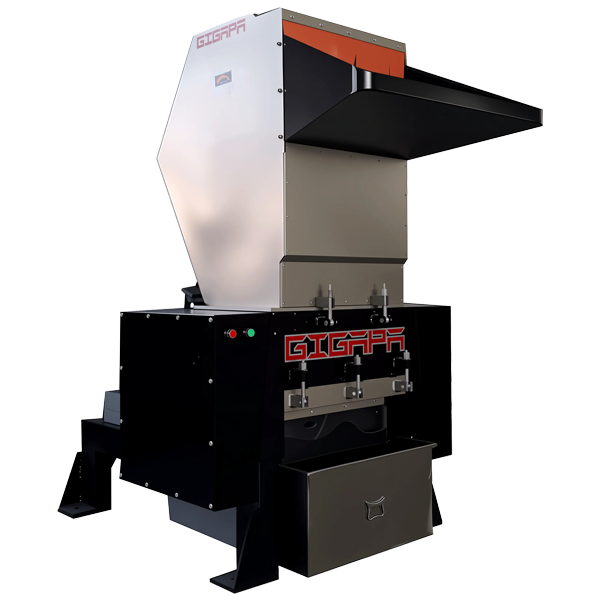
Detailed Breakdown of Key Components and Their Functions
A plastic granulator machine’s efficiency and reliability depend on the synergy of its core components.
1. Feeding Hopper
The hopper is the entry point for plastic material. Its design is crucial for safety and efficiency. Modern plastic granulator machines feature sound-dampening and splash-proof hoppers to reduce noise and contain fragments. An integrated ram feeder or conveyor belt may be used for automated, continuous feeding of large volumes, optimizing throughput.
2. Cutting Chamber: The Heart of the Machine
This sealed compartment houses the cutting mechanism. Its robust construction withstands the significant forces and vibrations generated during operation.
-
Rotor Assembly: The rotor is a central steel shaft mounted with multiple helical or staggered knives (rotor knives). It is powered by a high-torque electric motor. The rotor’s design—whether open, closed, or scalloped—affects the cutting efficiency, noise level, and ability to handle different material types.
-
Cutting Knives: The interaction between the rotor knives and the stationary bed knives creates the scissor-like shear action. These knives are made from high-grade alloy tool steel and are heat-treated to extreme hardness for longevity and sharpness. Proper knife gap adjustment is vital for clean cuts and energy efficiency.
-
Screen Mesh (Sieve): Positioned beneath the rotor, the screen acts as a size control gate. It is a perforated steel plate with circular or square holes determining the maximum granule size. Screen size is selected based on the desired end product. For example, a 10mm screen produces larger flakes for washing lines, while a 6mm screen creates finer regrind for direct injection molding.
3. Drive System
This system provides the power. It typically consists of:
-
Electric Motor: Provides rotational energy. Motors are sized based on the machine’s capacity and the toughness of the plastic.
-
Transmission System: A V-belt drive is common, as it acts as a safety buffer by slipping in case of a severe overload, protecting the motor and rotor. Direct drives are used in some high-torque applications for maximum power transfer.
4. Discharge and Conveyance System
Once granules pass through the screen, they must be removed from the cutting chamber.
-
Forced Discharge Systems: Fans or blowers create an air stream that pushes granules through a discharge duct. This is highly efficient, prevents screen clogging, and allows for flexible routing of output to storage bags, silos, or the next stage in a production line.
-
Gravity Discharge: Simpler machines may rely on gravity, where granules fall directly into a container placed below.
5. Control Panel & Safety Systems
Modern plastic granulator machines are equipped with user-friendly PLC-based control panels. Key safety features are non-negotiable:
-
Electrical Interlocks: The machine cannot start if the cutting chamber access door is open.
-
Overload Protection: Sensors monitor motor current and automatically reverse the rotor or shut down the machine if a jam is detected.
-
Emergency Stop Buttons: Prominently placed for immediate shutdown.
Advanced Focus: The Single-Shaft Crusher as a Secondary Granulator
As referenced in the technical description provided, the single-shaft crusher represents a specific, advanced class of plastic granulator machine often used for secondary size reduction.
-
High-Speed Precision Cutting: Operating at high rotational speeds, its blades make rapid, continuous cuts against the stationary bed knife. This action produces an exceptionally uniform granulate.
-
Role as a Secondary Crusher: It is typically fed with pre-shredded plastic flakes. Its job is to refine these flakes into very small, clean-cut granules. The small screen mesh size (e.g., 3mm to 8mm) is a hallmark of this stage.
-
Superior Output Quality: The granules produced are dense, low in dust, and free of “fines.” This quality is essential for high-end recycling applications and for ensuring smooth operation in downstream equipment like pelletizing extruders, where consistent feed size is critical for stable melting and high-quality pellet production.
-
Space-Saving Air Discharge: The integrated air discharge device (a powerful blower) pneumatically conveys the output. This eliminates the need for bulky mechanical conveyors, saving significant floor space and offering unparalleled flexibility in directing the final discharge to storage or the next processing station.
Industrial Applications and Material Suitability
Plastic granulator machines are versatile but are selected based on material type:
-
Hard Plastics (Injection Molding Scrap): ABS, PS, PC, PP, and acrylic sprues, runners, and rejected parts are ideal for granulation. They produce high-value regrind.
-
Films and Soft Plastics: LDPE films, bags, and stretch wrap require specialized knife designs and feeding systems to prevent wrapping around the rotor.
-
Purgings and Lumps: Large, dense plastic lumps from extruder or injection molding purges demand a heavy-duty plastic granulator machine with high torque and a rugged cutting chamber.
Conclusion: The Engine of the Circular Economy
Understanding how a plastic granulator machine works reveals it as more than just a crusher. It is a precision-engineered system that transforms waste into a resource through controlled shear cutting. From its hardened steel knives and sizing screen to its intelligent safety and discharge systems, each component plays a role in achieving efficient, reliable, and safe size reduction.
The advanced single-shaft crusher, in particular, exemplifies the technological progression in this field, delivering the high-quality granules demanded by today’s sophisticated recycling and manufacturing processes. By integrating such equipment, businesses not only achieve significant cost savings through raw material recovery but also actively contribute to a sustainable, circular economy for plastics. For any operation handling plastic scrap, the plastic granulator machine stands as an indispensable asset for profitability and environmental stewardship.