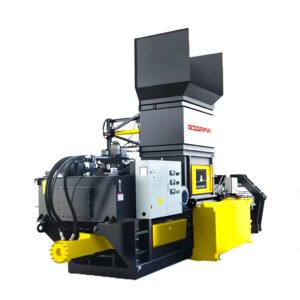
-200x45.png)
With the rapid development of the global automotive industry, the number of waste tyres generated annually continues to increase, and waste tire recycling has become a major problem. Waste tyres are bulky, durable, and difficult to decompose, making them one of the most challenging materials in solid waste management. Without proper treatment, they occupy large storage areas and pose serious environmental and safety risks.
To address these challenges, modern waste tyre recycling relies heavily on two key types of equipment: waste tyre shredders and tyre baler machines. This article explains how shredders and balers work together to improve tyre processing efficiency and support sustainable recycling solutions.
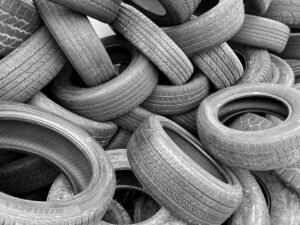
Challenges in Waste Tire Recycling
Recycling waste tyres is far more complex than handling ordinary municipal or industrial waste. Several inherent characteristics of tires create significant technical and logistical challenges.
- Waste tyres have a large volume and strong elasticity. Even when stacked, they trap air and quickly rebound, making them difficult to compress or store efficiently. This leads to high storage costs and poor space utilisation.
- Most tyres contain steel wire reinforcement and textile fibres. These materials improve tyre strength during use but significantly increase wear on recycling equipment. Processing tyres, therefore, requires machines with high torque, strong structures, and wear-resistant components.
- Waste tyres are expensive to transport. Because of their size and shape, unprocessed tyres result in low container loading efficiency. Transportation costs can account for a large portion of total recycling expenses, especially for facilities located far from collection points.
Due to these challenges, an efficient tyre recycling system almost always includes both size reduction and volume reduction as essential pre-treatment steps.
Role of Waste Tire Shredders in Tire Recycling
What Is a Waste Tyre Shredder?
A waste tyre shredder, also known as a tyre shredding machine, is designed to reduce whole or pre-cut tyres into smaller rubber pieces. These shredded materials can then be processed further or used in various recycling applications.

Typical materials processed include:
- Passenger car tyres
- Truck and bus tyres
- Off-the-road (OTR) tyres (after pre-cutting)
Advantages of Single-Shaft Shredders for Tires
Among different types of shredders, the single shaft shredder for tires is widely used in waste tire recycling projects due to its reliable performance and simple structure.
Key advantages include:
- Low-speed, high-torque operation for tough rubber materials
- Wear-resistant blades designed to handle steel wire
- Controlled output size for downstream processes
- Stable operation and low maintenance requirements
After shredding, tyres are transformed into uniform rubber blocks, which are suitable for further grinding, pyrolysis, or use as alternative fuel (RDF).
Tire Baler Machines in Waste Tire Handling
Why Use a Tyre Baler Machine?
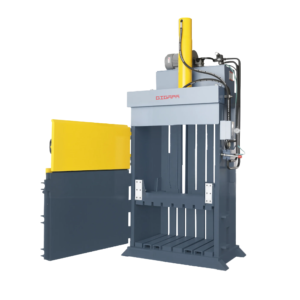
In many real-world scenarios, waste tyres are not processed immediately after collection. Recycling facilities often need to store tyres temporarily or transport them to centralised processing plants. In these cases, a tyre baler machine becomes an essential piece of equipment.
Loose waste tyres:
- Take up excessive storage space
- Reduce container loading efficiency
- Increase transportation costs
A waste tyre baling solution compresses tyres into dense, rectangular or cylindrical bales using hydraulic pressure. These bales are easy to stack, store, and transport.
Benefits of Waste Tire Baling Solutions
A tyre baler machine offers several practical benefits:
- Significant volume reduction
- Lower storage and warehouse costs
- Higher transport and container loading efficiency
- Suitable for export and centralised recycling
Tyre baling is widely used by tyre collection centres, recycling stations, and waste management companies. In international trade, baled tyres are often exported to countries with specialised recycling facilities, making balers an important part of global tyre recycling networks.
Integrated Shredder and Baler Solutions for Waste Tires
In real-world projects, shredders and balers are often used together as part of a complete tyre recycling equipment solution.
Solution 1: Tire Baling Before Centralised Recycling
Application scenarios:
- Tire collection centres
- Transfer stations
- Waste tyre exporters
Process flow:
Waste tyres → Tire baler machine → Transportation → Centralised shredding or recycling
Solution 2: Direct Tire Shredding for Material Recycling
Application scenarios:
- Rubber recycling plants
- Pyrolysis and energy recovery projects
- RDF fuel production
Process flow:
Waste tyres → Waste tyre shredder → Rubber blocks → Further processing
Solution 3: Shredding and Then Baling
Application scenarios:
- Long-distance transportation of shredded materials
- Commercial sale of shredded tyre rubber
Process flow:
Waste tyres → Tire shredding machine → Shredded rubber → Baling → Transport or export
Key Factors When Choosing Tire Recycling Equipment
When selecting shredders and balers for waste tyre recycling, several factors should be carefully evaluated:
- Tire size and daily processing capacity
- Steel wire content and blade durability requirements
- Final application of shredded or baled materials
- Maintenance costs and operational stability
- Level of automation and safety features
Working with an experienced manufacturer can help ensure that the waste tyre shredder and tyre baler machine are properly matched to real operating conditions.
Conclusion: Efficient Waste Tire Recycling Starts with the Right Equipment
Waste tyres are no longer just an environmental burden—they are a valuable recyclable resource. By combining tyre shredding machines for size reduction and tyre baler machines for volume compression, recycling facilities can significantly improve operational efficiency and reduce overall costs.
As environmental regulations become stricter and demand for sustainable recycling grows, reliable waste tyre recycling equipment will continue to play a critical role in the global circular economy.