-200x45.png)
The difference in efficiency between double-shaft shredders and single-shaft shredders is mainly reflected in the working principle, structural design, applicable scenarios, etc. The following is a specific comparative analysis:
Core working principle and structural differences
1. Single-shaft shredder
- Structural features: There is only one rotating main shaft, on which multiple blades (moving knives) are installed, and a fixed knife seat (fixed knife) is provided.
- Working principle: The moving knife is driven to rotate by the main shaft, and a shear force is formed with the fixed knife to tear, squeeze or cut the material into small pieces.
- Power characteristics: Depends on the torque and speed of a single main shaft, and the power is relatively concentrated.
2. Double-shaft shredder
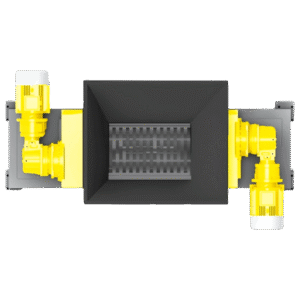
- Structural features: Contains two parallel main shafts (driving shaft and driven shaft), and the blades on the two shafts are staggered to form a “gear bite” shape.
- Working principle: The two shafts rotate in opposite directions, and the blades shear and tear the materials against each other, while using the friction and extrusion force between the shafts to crush the materials.
- Power characteristics: The synergy of the two shafts has greater torque and stronger ability to grab and crush materials.
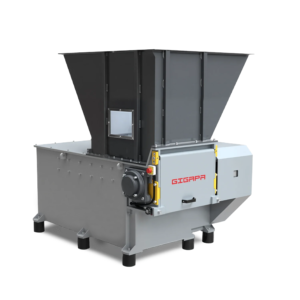
Efficiency comparison: double shaft vs single shaft
1. Processing efficiency
Double shaft shredder:
- Advantages: The mechanism of double shaft synchronous shearing makes it more capable of grabbing materials, especially suitable for processing high-toughness, large volume or entangled materials (such as plastic barrels, tires, scrap metal, etc.). Since the two shafts act at the same time, the material will be quickly “bitten” and torn after entering the crushing chamber, reducing slippage or jamming.
- Efficiency performance: fast crushing speed, large processing capacity, suitable for scenes requiring efficient coarse or medium crushing.
Single shaft shredder:
- Advantages: simple structure, relatively high speed, suitable for processing brittle, loose or small and medium volume materials (such as domestic garbage, paper, plastic film, etc.).
- Efficiency performance: The processing efficiency of a single type of easily broken materials is high, but when facing hard or tough materials, it may take multiple rotations to complete the crushing, which takes a long time.
2. Energy efficiency
Double-shaft shredder:
Due to the coordinated work of the two shafts, the torque distribution during crushing is more uniform, and the processing capacity per unit energy consumption is higher. It is especially suitable for processing hard materials and is not prone to shutdown due to overload.
Single-shaft shredder:
Relying on the torque of a single main shaft, it may require higher power when processing hard materials, with relatively high energy consumption, and it is easy to cause motor overload due to material jamming.
3. Efficiency difference in applicable scenarios
Double-shaft shredder:
Relatively speaking, the double-shaft shredder is more suitable for processing industrial solid waste with large volume, high strength and complex mixture. It uses two knife shafts rotating in opposite directions to shear and tear, does not rely on screen control, and can quickly process large or difficult-to-crush materials such as waste tires, metal shells, car bumpers, oil drums, electrical housings, and large pieces of hard plastic. Therefore, double-shaft shredders are often found in large recycling centers, domestic waste sorting lines, electronic waste treatment sites and other places with high requirements for crushing capacity.
In terms of processing efficiency, the double-shaft shredder has higher processing capacity. Its two knife shafts can quickly bite and shred materials by co-rotating, even high-strength items such as metal barrels and tires can be easily crushed. The processing volume per unit time is usually several times that of the single-shaft model, which is suitable for industrial scenarios that require high-throughput processing. Since there is no need for hydraulic pushing, the equipment has good operation continuity, especially suitable for batch operation.
Single-shaft shredder:
Single-shaft shredders are mainly suitable for processing materials with light structure, medium volume, soft material or strong toughness. Common processing objects include plastic products, rubber, fiber, wood, cable, paper and film materials. Its structural design is usually equipped with a hydraulic pusher to ensure that the material is continuously and stably pushed to the cutter shaft, thereby achieving efficient crushing. Since the single-shaft crusher can be used with a screen, it has a strong ability to control the particle size of the output material, and is suitable for processes that require fine crushing or subsequent re-granulation.
Although the unit processing capacity of the single-shaft crusher is relatively low, its advantage is that the particle size of the output material is more uniform and controllable. The screen system it carries can control the size of the output material, which is suitable for refined processing. For some industries that require subsequent granulation, pressing or high-quality recycling, this controllability is a necessary condition. In addition, the single-shaft machine has low noise during operation, simple maintenance, and higher operating safety, so it is widely used in recycled resource industries such as plastics, wood, and rubber.

Other factors affecting efficiency
Blade design and wear resistance:
Double-shaft shredder blades are usually made of alloy materials (such as manganese steel, carbide), which are more wear-resistant and suitable for long-term processing of hard materials, reducing the frequency of replacement and indirectly improving efficiency.
Single-shaft shredder blades pay more attention to cutting sharpness and are efficient when processing soft materials, but are easy to wear when processing hard objects and require regular maintenance.
Feeding method and discharge size:
Double-shaft shredders are usually equipped with forced feeding devices (such as press feeders), which can feed continuously and have a relatively uniform discharge size, which is suitable for large-scale production.
Single-shaft shredders rely on the weight of the material to fall into the crushing chamber, with a slow feeding speed and large fluctuations in discharge size, which is suitable for small and medium-sized scenarios.
Maintenance complexity:
Double-shaft shredders have a complex structure and maintenance (such as blade adjustment and bearing lubrication) takes a long time. If maintenance is not timely, it may affect efficiency.
Single-shaft shredders are simple to maintain and are suitable for high-frequency small operations that require quick start and stop.
How to choose: Decision-making suggestions for efficiency priority
Prefer double-shaft shredders:
- Need to process high-hardness, high-toughness, and large-volume materials (such as industrial solid waste, scrapped cars, and large pieces of garbage).
- Seek high processing capacity and low energy consumption, or need continuous and stable operation (such as coarse crushing at the front end of the production line).
Prefer single-shaft shredders:
- Process soft, brittle, small and medium-sized materials (such as household garbage, food waste, and plastic bottles).
- Limited budget, small site, or the need to flexibly switch between the types of materials processed (such as a small recycling station).
In summary, single-shaft crushers and double-shaft crushers each have their own advantages and are suitable for different materials and processing requirements. According to the actual application scenario, material characteristics and production requirements, reasonable selection of equipment type will help improve overall processing efficiency and operational benefits.