-200x45.png)
A vertical baler provides an efficient solution for businesses in agriculture, chemical manufacturing, animal feed, fertilizer, food processing, and recycling industries that handle large quantities of PP woven bags. Widely used for packaging and transportation, these bags can quickly accumulate and occupy valuable storage space. By collecting, compressing, and organizing used or empty woven bags into compact bales, a vertical baling machine helps businesses reduce storage requirements, improve handling efficiency, and simplify transportation.
A vertical baler for woven bags provides a practical solution. By compressing loose woven bags into compact bales, a vertical baling machine can significantly reduce storage space, simplify transportation, and improve overall material handling efficiency.
For manufacturers, warehouses, recycling companies, and packaging facilities, choosing the right woven bag baling machine can help reduce labor costs while making the entire packaging or recycling process more organized.
What Is a Vertical Baler for Woven Bags?
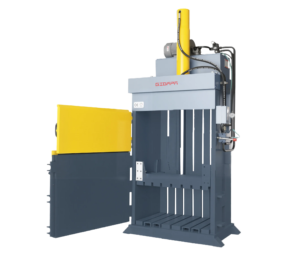
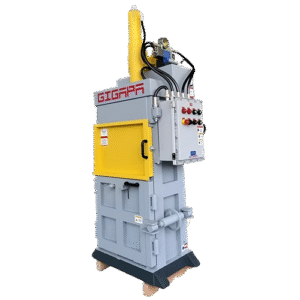
A vertical baler for woven bags is a hydraulic or mechanical baling machine designed to compress loose PP woven bags and other flexible packaging materials into compact, manageable bales.
Unlike horizontal balers, vertical baling machines generally have a smaller footprint and are loaded from the top or front, depending on the machine design. This makes them particularly suitable for facilities where floor space is limited.
The basic working process is straightforward:
- Collect used or empty woven bags.
- Place the bags into the baling chamber.
- Start the hydraulic compression system.
- Compress the material into a dense bale.
- Tie or strap the bale.
- Open the chamber and remove the finished bale.
The resulting bale is much easier to stack, store, handle, and transport.
Why Use a Baling Machine for Woven Bags?
Although PP woven bags are lightweight, they can take up a surprisingly large amount of space when they are loosely piled. This creates several problems for factories and recycling facilities.
1. Reduce Storage Space
Loose woven bags contain a large amount of air. A vertical baler removes much of this air by applying high compression force.
Depending on the machine model and material condition, compressed bales can occupy only a fraction of the original volume. This allows companies to make better use of warehouses, production areas, and temporary storage spaces.
2. Improve Transportation Efficiency
Loose woven bags are difficult to load efficiently onto trucks or containers. Their irregular shape creates large gaps between individual bags.
After baling, the material becomes compact and uniform. More material can therefore be loaded into the same transportation space, helping reduce transportation frequency and logistics costs.
3. Reduce Manual Labor
Without a baling machine, workers may need to manually collect, fold, bundle, and tie woven bags. This process is time-consuming and physically demanding.
A hydraulic vertical baler can automate the most labor-intensive part of the operation—the compression process. Operators mainly need to load the material, activate the machine, and secure the finished bale.
4. Improve Workplace Organization
Loose PP bags can quickly create clutter around production lines and warehouses. Baling helps keep waste and reusable packaging materials organized.
Compact bales are easier to stack and move with hand pallet trucks, forklifts, or other material-handling equipment.
5. Increase Recycling Value
Used PP woven bags can often be recycled into plastic products after proper collection and processing. Compact bales make recyclable materials easier for recycling companies to collect, sort, transport, and process.
For recycling businesses, a woven bag baling machine can therefore become an important part of the material preparation process.
How Does a Vertical Woven Bag Baler Work?
Most hydraulic vertical balers use a hydraulic cylinder to generate compression force.
First, the operator places loose woven bags into the baling chamber. The chamber is then closed, and the hydraulic system activates the pressing plate.
The hydraulic cylinder pushes the plate downward, compressing the bags inside the chamber. Once the desired compression level or bale size is reached, the material is secured using plastic straps, PP bands, wire, or other suitable tying materials.
After tying, the compression plate returns to its original position. The chamber is opened, and the finished bale is removed.
The entire cycle can then be repeated.
The actual operating procedure varies according to the machine’s design, automation level, bale size, and hydraulic system.
Key Features to Consider When Choosing a Vertical Baler
Not every baling machine is suitable for woven bags. Before purchasing a machine, buyers should evaluate several important specifications.
- Compression Force
Compression force determines how effectively the machine can compact the material.
For woven bags, the required force depends on factors such as bag thickness, material condition, moisture content, and desired bale density.
A machine with an appropriate hydraulic pressure and cylinder capacity can produce stable and dense bales without unnecessarily increasing energy consumption.
- Bale Size
Bale dimensions are another important consideration.
Smaller bales may be easier for manual handling, while larger bales can improve transportation efficiency. The ideal bale size depends on the customer’s storage area, transportation method, and handling equipment.
When selecting a vertical baler, consider where the finished bales will be stored and how they will be moved.
- Chamber Size
The size of the pressing chamber determines how much woven bag material can be loaded per cycle.
A larger chamber can increase the amount of material processed per cycle, but it also requires more installation space. For small workshops or warehouses, a compact vertical baler may be more practical.
- Hydraulic System
The hydraulic system is one of the most important components of a vertical baling machine.
A reliable hydraulic system should provide stable pressure, smooth operation, and consistent compression performance. Buyers should also pay attention to hydraulic components, seals, cylinders, pumps, and valves when comparing different machines.
- Operating Method
Vertical balers can range from relatively simple manual models to semi-automatic machines with advanced controls.
For small and medium-sized businesses, a simple control system may be sufficient. High-volume operations may benefit from a more automated machine that reduces operator involvement and improves production efficiency.
Applications of Vertical Baling Machines for Woven Bags
Vertical woven bag balers can be used in a variety of industries.
- Agriculture and Fertilizer Industry
Fertilizers, grains, seeds, animal feed, and other agricultural products are frequently packaged in PP woven bags. After packaging or unloading, large quantities of empty bags may accumulate.
A vertical baler can compress these bags for storage, recycling, or transportation.
- Chemical IndustryMany chemical products use woven polypropylene bags for packaging. Manufacturing and distribution facilities can use baling equipment to handle empty packaging bags efficiently.
- Food and Feed ProcessingFlour, rice, grain, pet food, animal feed, and other bulk products may use woven bags. A baling machine can help facilities manage empty bags generated during production and repackaging.
- Recycling CentersRecycling facilities often receive large quantities of used PP woven bags. Compressing these materials into dense bales makes sorting, storage, transportation, and further processing easier.
- Packaging and Manufacturing FacilitiesFactories that use large quantities of woven bags can install a vertical baler near the packaging or waste collection area. This can reduce the accumulation of empty bags and improve material flow within the facility.
Advantages of a Vertical Baler for Small and Medium Businesses
One of the biggest advantages of a vertical baling machine is its relatively compact design.
Large industrial baling systems may require conveyors, automated feeding systems, and significant installation space. A vertical baler can often provide a simpler solution for businesses that do not need extremely high throughput.
Its main advantages include:
- Compact footprint
- Lower initial investment compared with some large automated systems
- Simple operation
- Reduced manual handling
- Lower storage requirements
- Easier transportation of compressed materials
- Suitable for various flexible packaging materials
- Convenient installation in warehouses and factories
These characteristics make vertical balers particularly attractive to businesses that need reliable compression without building a large automated recycling line.
What Materials Can Be Baled Besides Woven Bags?
Although this article focuses on woven bags, many vertical hydraulic balers can process other compressible materials.
Depending on the machine’s specifications, common materials may include:
- PP woven bags
- PE bags
- Plastic film
- Stretch film
- Packaging waste
- Cardboard
- Paper
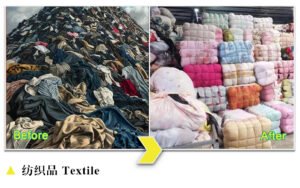
- Textile waste
- Agricultural plastic
- Lightweight industrial waste
However, material compatibility should always be confirmed with the equipment manufacturer before operation. Different materials may require different compression forces, chamber configurations, or tying methods.
Conclusion
A vertical baler for woven bags is a practical solution for companies that need to compress, store, transport, or recycle large quantities of PP woven bags.
By turning loose and bulky bags into compact bales, a woven bag baling machine can reduce storage requirements, improve transportation efficiency, lower manual handling requirements, and create a cleaner working environment.
For small and medium-sized factories, warehouses, agricultural businesses, packaging companies, and recycling facilities, a vertical hydraulic baler can provide an efficient balance between performance, footprint, investment cost, and ease of operation.
Before choosing a machine, buyers should carefully evaluate compression force, bale size, chamber dimensions, processing capacity, hydraulic system, operating method, safety features, and after-sales support.